



Random Picker Wheel vs Random Number Generator: Which Is Better?
Choosing randomly sounds simple—until fairness, transparency, speed, and the user experience actually matter.
Imagine you need to choose one winner from 100 giveaway participants. Or perhaps you need to select a student to answer a question, pick a random team for a game, choose a restaurant for dinner, or generate a number between 1 and 100. You could use a random picker wheel, a random number generator (RNG), or another random selection tool.
At first glance, these tools appear to do the same thing: they produce a random result. But they are designed for different situations.
The real question is not simply whether a wheel or number generator is “more random.” The better question is: Which method provides the right combination of randomness, fairness, transparency, convenience, and user engagement for your specific task?
In this guide, we’ll compare a random picker wheel vs random number generator, explain how both approaches work, look at the technology behind digital randomness, and show when each tool makes the most sense.
Try : Yes or No Wheel
Random Picker Wheel vs Random Number Generator: What’s the Difference?
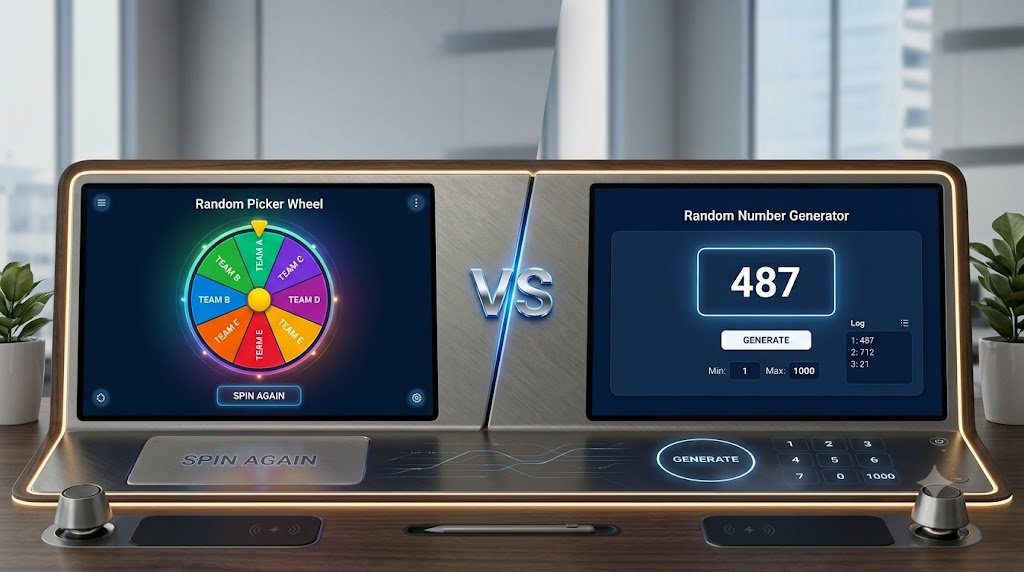
A random picker wheel is a visual randomization tool that represents choices as segments on a spinning wheel. You enter names, numbers, options, teams, or other choices, spin the wheel, and allow the wheel to select one result.
A random number generator, on the other hand, typically produces a numerical value within a specified range. For example, you might ask it to generate a number between 1 and 100, and it could return 47.
Both can perform random selection, but their user experiences are very different.
How a Random Picker Wheel Works
A digital spin wheel normally begins with a list of options. Each option becomes a segment of the wheel.
For example:
- Alice
- Brian
- Carlos
- Diana
- Emma
The wheel displays these names visually. When you click spin, the spin wheel animation creates the experience of watching the wheel rotate before stopping at a selected option.
This makes the visual selection process easy for other people to follow.
A teacher can display the wheel on a classroom screen. A streamer can share it with an audience. A giveaway host can spin it live while participants watch.
This is one of the biggest advantages of a wheel: the randomness becomes visible.
How a Random Number Generator Works
A random number generator (RNG) focuses on generating numerical outcomes.
Suppose you have 500 entries and assign each participant a number from 1 to 500. Instead of displaying all participants on a wheel, you can use a random number generator and request a random number range from 1 to 500.
If the generator returns 327, participant #327 becomes the winner.
This approach is usually faster and more convenient when the input is naturally numerical.
An RNG can also be useful for:
- Statistical sampling
- Simulations
- Programming
- Testing
- Mathematical experiments
- Random digits generation
- Number selection
- Probability experiments
The key distinction is therefore straightforward:
A random picker wheel is optimized for visual choice and interaction, while an RNG is optimized for numerical randomization.
Randomness, Fairness, and How Random Selection Actually Works
One common misconception is that a wheel must automatically be more or less random than a number generator simply because it looks different.
The visual appearance of a tool does not determine its underlying randomness.
What matters is the randomization algorithm, source of randomness, implementation, and rules used by the software.
What Does “Random” Actually Mean?
True randomness is surprisingly difficult to define and produce computationally.
A computer is a deterministic machine. Given the same internal conditions and algorithm, it can generally produce the same output.
That is why many applications use a pseudorandom number generator.
A pseudorandom generator uses an algorithm to produce sequences that appear random. Some systems use a random seed to initialize the process.
One well-known example is Mersenne Twister, a pseudorandom number generator designed to produce long sequences with useful statistical properties.
Mersenne Twister can be excellent for simulations, games, and statistical applications, but it is not designed to provide cryptographic security.
Pseudorandom vs True Random Number Generation
The phrase true random number generation usually refers to randomness derived from a physical or unpredictable process rather than a deterministic mathematical sequence.
For example, a quantum random number generator can derive randomness from quantum phenomena.
There is an important distinction between:
- Pseudorandom number generation
- True random number generation
- Cryptographically secure randomness
For everyday random selection, you generally don’t need quantum-level randomness.
If you’re choosing who should bring snacks to a meeting, an ordinary randomization algorithm is more than sufficient.
However, applications involving security, authentication, encryption, tokens, or sensitive lotteries may require cryptographically secure randomness.
Browser-Based Randomness
Modern web applications can also use browser-based randomness.
In JavaScript environments, crypto.getRandomValues() provides access to cryptographically strong random values supported by the browser.
That makes it fundamentally different from simply using a predictable mathematical sequence.
However, whether a particular online wheel or number generator uses a cryptographically secure source depends on its implementation. You should not assume that every website uses the same randomization method.
Does a Wheel Have Equal Probability?
This is where equal probability becomes important.
Suppose a wheel contains ten equally sized segments and each segment represents one participant.
Ideally, each participant should have the same probability of being selected.
If there are ten equally weighted choices:
Probability of each choice = 1 / 10 = 10%
But what if one segment is twice as large as another?
Then the wheel may intentionally or unintentionally introduce a different wheel segment probability.
This leads to an important concept: unbiased random selection.
For a fair selection, every eligible option should have the intended probability of winning.
Random Picker Wheel vs RNG: Which Is Better for Different Situations?
There isn’t one universal winner.
The best tool depends on what you’re trying to accomplish.
1. For Everyday Decisions: Random Picker Wheel
A wheel is particularly useful when the choices are things rather than numbers.
For example:
“Should I watch a movie, read a book, play a game, or go for a walk?”
You could type those choices into a random selection wheel and spin it.
The result feels more natural than generating a number and creating a separate mapping between numbers and activities.
This is why a wheel works well as a random decision maker.
It can help with:
- Everyday decisions
- Restaurant selection
- Weekend activities
- Game selection
- Group decisions
- Task assignments
- Icebreakers
The objective isn’t advanced statistical analysis. It’s simply eliminating unnecessary overthinking.
2. For Numbers: Random Number Generator
If the task is already numerical, an RNG is generally more efficient.
For example:
Pick a number between 1 and 1,000.
A number range randomizer can immediately generate a result.
You may also need:
- Random number interval
- Minimum value
- Maximum value
- Random digits generator
- Excluded values
For example, you could generate a number from 1 to 100 while asking the system to exclude numbers from random selection.
This makes an RNG particularly practical for mathematical and technical applications.
3. For Names: Random Picker Wheel
Suppose a teacher has 30 students and wants to select someone to answer a question.
A random name picker is more intuitive than assigning every student a number.
You can display the names directly and spin.
This is particularly effective for classroom student selection.
A classroom random name picker can make participation feel more interactive while reducing the perception that the teacher is choosing students manually.
The same principle applies to random selection for classrooms.
4. For Giveaways: Random Picker Wheel
Giveaways are another situation where a wheel often has an advantage.
Imagine you’re conducting a live Instagram, YouTube, Twitch, or event giveaway.
You could announce:
“Let’s spin the wheel and find our winner.”
Everyone can see the selection happen.
A random winner picker, giveaway winner selector, or raffle winner picker can therefore be valuable when audience confidence matters.
The wheel doesn’t just produce a result—it provides an experience.
5. For Programming and Statistical Sampling: RNG
If you’re writing software or performing statistical sampling, a conventional RNG is usually more appropriate.
Developers may need programmatic random number generation for:
- Simulations
- Game mechanics
- Testing
- Randomized algorithms
- Data sampling
- Statistical models
- Randomized experiments
A developer may also use an RNG API integration to generate random values inside another application.
This is very different from spinning a visual wheel in a browser.
Transparency, User Engagement, and the Human Side of Random Selection
This is where the comparison becomes more interesting.
Technically, a number generator can be perfectly suitable for random selection. But humans don’t always evaluate randomness purely from a technical perspective.
They also care about whether the process looks fair.
Picker Wheel Transparency
Imagine you’re hosting a giveaway with 50 people.
You say:
“The winner is number 37.”
Even if your random number generator is completely fair, the audience doesn’t necessarily see how the selection happened.
Now compare that with:
“Here are all 50 participants. I’m going to spin the wheel live.”
The second approach provides picker wheel transparency.
Participants can visually confirm:
- Who is included
- How many options exist
- That the wheel is being spun
- Which result was selected
This creates visual transparency.
Audience Trust
Randomness isn’t only about mathematics.
It’s also about perception.
When people participate in a competition, giveaway, classroom activity, or event, they want confidence that the process wasn’t manipulated.
That is why audience trust can be an important advantage of a visible wheel.
A wheel can make the selection process easier to understand, especially for non-technical audiences.
User Engagement
A number appearing on a screen isn’t necessarily exciting.
A wheel spinning through dozens of names creates suspense.
The spin wheel animation can turn a simple selection into a small event.
This makes a digital spin wheel particularly effective for:
- Live giveaways
- YouTube streams
- Twitch streams
- Classroom activities
- Team games
- Events
- Social media content
In these environments, user engagement can matter almost as much as the random result.
Decision-Making Efficiency
There is another psychological advantage.
Sometimes the problem isn’t randomness.
It’s indecision.
You have three restaurants in mind. You keep comparing reviews. You ask friends. You check menus. Twenty minutes later, you’ve still chosen nothing.
A random wheel can turn that endless loop into a decision in seconds.
That’s where a wheel can function as a decision-making tool.
The goal isn’t to make the “perfect” decision.
The goal is to eliminate unnecessary friction when all options are acceptable.
Advanced Features: From Simple Wheels to Powerful Random Selection Tools
Modern online wheels have evolved beyond simple spinning animations.
A good random wheel generator may include features that make it useful for classrooms, games, events, giveaways, and everyday decisions.
Wheel Customization
Customization can make a wheel easier to understand and more engaging.
Depending on the platform, you may be able to add:
- Custom wheel segments
- Custom colors and images
- Names
- Numbers
- Categories
- Icons
- Labels
This makes the tool adaptable to different use cases.
For example, a teacher could create a wheel containing student names, while a game host could create a wheel containing challenges.
Elimination Mode
Suppose you have 20 participants and need to select five winners.
You don’t necessarily want the same participant selected five times.
An elimination mode can remove the selected option after each spin.
The process becomes:
- Spin the wheel.
- Select a winner.
- Remove the winner.
- Spin again.
- Repeat.
This is particularly useful for random selection for events, giveaways, games, and classroom activities.
Weighted Random Selection
Not every random process requires equal probability.
A weighted wheel allows certain options to have different probabilities.
For example:
- Option A: 50%
- Option B: 30%
- Option C: 20%
This is known as weighted random selection.
It can be useful in simulations, games, prize systems, or situations where different outcomes intentionally have different probabilities.
However, weighted selection should not be confused with fairness when everyone is supposed to have an equal chance.
If a giveaway promises equal chances, using a weighted wheel without clearly explaining it would undermine selection fairness.
Random Selection History
Another useful feature is random selection history.
If you perform multiple selections, keeping a record of previous results can make the process easier to review.
A spin result history can show previous selections and help prevent accidental duplicate choices.
This becomes especially useful during:
- Multi-round games
- Classroom activities
- Giveaways
- Team assignments
- Events
Save and Share Wheel
If you regularly use the same list of options, rebuilding it every time is inconvenient.
A save and share wheel feature lets users preserve their configuration and potentially send it to others.
Shareable random results can also be useful when participants aren’t physically in the same location.
For example, a remote team can use the same wheel during an online meeting.
Random Team Selection
Team formation is another excellent use case.
Suppose you have 24 students and need six teams.
You could create a wheel containing student names and randomly assign participants.
Alternatively, a number generator could produce assignments based on predetermined numbers.
For people watching the process, however, the wheel often feels easier to understand.
Physical vs Digital Spin Wheel: Which One Is More Random?
Before digital tools became common, people used physical wheels, drawing lots, shuffled cards, dice, and other mechanisms for random selection.
Today, a physical vs digital spin wheel comparison raises an interesting question.
Is a physical wheel inherently more random?
Not necessarily.
A physical wheel is influenced by mechanical factors such as:
- Starting position
- Spin force
- Friction
- Wheel construction
- Pointer design
- Segment size
- Human technique
A digital wheel can instead use a software-based randomization process.
Therefore, the physical appearance of a wheel does not automatically guarantee superior randomness.
What About Randomness Verification?
For casual decisions, you generally don’t need sophisticated randomness verification.
But when randomness is critical, you may want to understand:
- What algorithm is being used?
- What source generates the random values?
- Are outcomes independently generated?
- Are all participants equally represented?
- Can the selection be reproduced?
- Is the process auditable?
This leads to the concept of a randomness audit.
A professional application may require testing and documentation to establish that its random process behaves as expected.
Statistical Randomness
A sequence can be statistically random-looking without being cryptographically secure.
This distinction matters.
Statistical randomness is often sufficient for simulations and many everyday applications.
Cryptographically secure randomness is designed for situations where predicting future outputs would create a security problem.
Therefore, asking whether a tool is “random enough” requires understanding the purpose.
Which Tool Should You Choose?
The simplest way to make the decision is to match the tool to the job.
| Use Case | Better Choice |
|---|---|
| Choose a name | Random picker wheel |
| Pick a student | Random name picker |
| Select a giveaway winner live | Random picker wheel |
| Pick a team member | Random picker wheel |
| Choose between activities | Random picker wheel |
| Generate 1 number from 1–100 | RNG |
| Generate random digits | RNG |
| Statistical sampling | RNG |
| Programming | RNG |
| Simulations | RNG |
| Randomized algorithms | RNG |
| Live audience participation | Random picker wheel |
| Classroom engagement | Random picker wheel |
| Numerical testing | RNG |
| Secure random tokens | Cryptographically secure RNG |
The decision can be summarized like this:
Choose a random picker wheel when people need to see and experience the selection.
Choose a random number generator when you primarily need a numerical result.
Neither is universally better.
Random Picker Wheel vs Random Number Generator: Frequently Asked Questions
1. Is a random picker wheel truly random?
A digital wheel can provide random selection when it uses an appropriate randomization algorithm and correctly implements the selection process. The visual spinning animation itself does not determine whether the underlying selection is random.
2. Is a random number generator more random than a wheel?
Not automatically. A wheel and an RNG can both rely on software-generated randomness. What matters is the underlying randomization method, implementation, probability rules, and source of randomness.
3. Which is better for choosing a giveaway winner?
A random picker wheel is often better for live giveaways because participants can see the selection process. A random number generator can also work, particularly when every participant has been assigned a unique number.
4. Is a random wheel fair?
It can be fair if every eligible option has the intended probability of selection. With equal-sized segments and an unbiased selection mechanism, each option can have an equal chance.
5. Can a random picker wheel be weighted?
Yes. Some wheels support weighted random selection, where different segments have different probabilities. This should only be used when unequal probabilities are intentional and properly disclosed.
6. What is the difference between a random wheel and a number wheel?
A random wheel can contain almost any type of option, including names, activities, teams, or numbers. A number picker wheel is specifically configured around numerical choices.
7. What is a random number generator used for?
A random number generator is commonly used for generating numbers within a specified range, simulations, statistical sampling, programming, games, testing, and other numerical applications.
8. Can I use a wheel for classroom student selection?
Yes. A classroom random name picker is particularly useful for selecting students without manually choosing who participates.
9. Can a wheel select random teams?
Yes. A wheel can support random team selection by assigning participants to teams through repeated selections or an appropriate team-assignment method.
10. What is elimination mode on a random wheel?
Elimination mode removes an option after it has been selected. This prevents the same option from being selected again during subsequent spins.
11. What is a pseudorandom number generator?
A pseudorandom number generator uses a deterministic algorithm to produce a sequence of values that appears random. Mersenne Twister is a well-known example used in many non-security applications.
12. What is cryptographically secure randomness?
Cryptographically secure randomness is designed to make generated values difficult to predict. It is important for security-sensitive applications where predictable random values could create vulnerabilities.
13. What is crypto.getRandomValues()?
crypto.getRandomValues() is a browser API that provides cryptographically strong random values for supported web environments. It can be used when an application requires stronger randomness than a conventional pseudorandom generator.
14. Is a quantum random number generator better?
A quantum random number generator can derive randomness from quantum phenomena and can provide genuine physical randomness. However, that does not mean it is necessary for ordinary decisions, classroom activities, or casual random selection.
15. Can random number generators be biased?
Yes. Bias can result from poor algorithms, incorrect implementation, uneven mapping of random values to outcomes, or other technical mistakes. Proper testing helps evaluate the quality of a randomization system.
16. What is wheel segment probability?
Wheel segment probability refers to the chance that a particular wheel segment will be selected. If all segments are intended to have equal probability, their representation and selection mechanism should support that outcome.
17. Is a random wheel good for everyday decisions?
Yes. A wheel is particularly useful when you have several acceptable choices but don’t want to spend excessive time deciding. It can act as a simple random decision maker.
18. Can I use a random wheel for games?
Absolutely. A random selection wheel can be used for challenges, player selection, prizes, tasks, teams, categories, and other game mechanics.
19. Which is better for statistical sampling?
A random number generator is generally more appropriate for statistical sampling, particularly when the sampling process requires numerical indexes, reproducibility, or programmatic integration.
20. Which is better: a random picker wheel or random number generator?
There is no single winner.
If you need visual transparency, user engagement, names, choices, classroom selection, giveaways, or live interaction, a random picker wheel is usually the better option.
If you need numbers, programming, simulations, statistical sampling, random intervals, or numerical data, a random number generator is generally more practical.
Final Verdict: Random Picker Wheel vs Random Number Generator
The debate over Random Picker Wheel vs Random Number Generator isn’t really about finding one tool that beats the other.
They’re designed to solve different problems.
A random picker wheel is excellent when the selection itself is part of the experience. Its visual interface makes randomness easy to understand, which is why it works particularly well for giveaways, classrooms, games, events, team selection, and everyday decisions.
A random number generator is better when you need a numerical output. It’s particularly useful for programming, statistical sampling, simulations, number ranges, random digits, and technical applications.
The most important consideration is not whether the result comes from a wheel or a number generator. It is whether the process provides the appropriate level of randomness and fairness for the task.
For casual decisions, convenience and engagement may matter most.
For a classroom, transparency may matter more.
For a live giveaway, audience trust can be critical.
For software development or statistical work, programmatic random number generation is usually the better choice.
And for security-sensitive applications, cryptographically secure randomness should be considered instead of relying on an ordinary pseudorandom process.
So, the next time you’re faced with a choice between a wheel and an RNG, ask yourself one simple question:
Do I need a random result—or do I need people to see and participate in the random selection process?
If it’s the first, reach for an RNG.
If it’s the second, spin the wheel.
Either way, the best random selection tool is the one that fits the job, provides the right level of fairness and transparency, and makes the decision easier rather than more complicated.
Also Read: Decision Maker Wheel: How to Stop Overthinking Small Decisions
[…] Also Read: Random Picker Wheel vs Random Number Generator […]